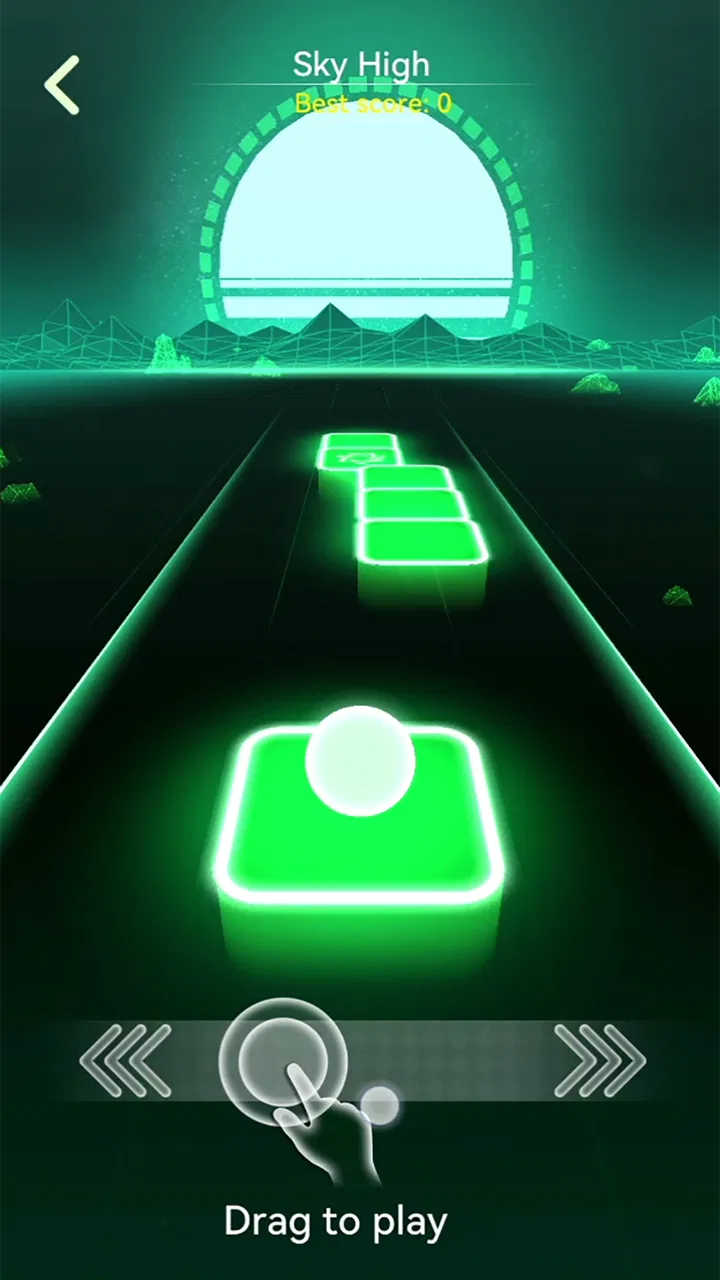
Music Ballz Hop
- 4.6
- Rating
- 10.00M
- Installs
- Free
- Price

 Analysis by App-foxy
I started Music Ballz Hop expecting a simple music game, and that is exactly where its appeal begins. You tap to make the ball jump, listen for the beat, and try to keep your timing under control. There is no long tutorial or complicated setup standing between opening the game and taking the first action. That immediacy makes it easy to understand within seconds, but the short path to play also means the quality of each session depends heavily on whether you enjoy repeating a small timing challenge.
As a free music game from SAMFEN LIMITED, it fits the kind of experience I reach for when I have a spare minute rather than when I want a deep campaign. The game is suitable for Everyone, works on Android devices running version 7.0 or later, and its current version is 0.0.18. It has attracted over ten million installs and holds a 4.8 average from around twenty-four thousand ratings, which suggests that the straightforward format has found a sizable audience. I would still judge it by the moment-to-moment play, because a large audience cannot tell you whether its rhythm suits your own habits.
One tap turns the music into a playable challenge
The first action is wonderfully clear: tap and the ball jumps. That single input is the whole doorway into the game. I did not have to learn a collection of buttons, memorize a character's abilities, or spend time arranging a loadout. The useful skill is anticipation. Instead of waiting until the ball is already in trouble, I found myself trying to read the next beat and make the tap early enough to keep the movement controlled.
You May Also Like

 AccuWeather: Weather Radar
AccuWeather Review: A Quick, Clear Forecast for Everyday Decisions
For everyday plans, the best forecast is the one you can understand quickly. AccuWeather makes rain timing, radar, and local conditions easy to act on, with a few trade-offs.

 Hill Climb Racing
Why Hill Climb Racing Still Turns Crashes Into One More Run
A tiny car, a bumpy hill and one more upgrade: Hill Climb Racing keeps resurfacing because its simple chaos makes every near-miss feel personal.

 AliExpress - Shopping App
AliExpress Makes Global Shopping Feel Personal, but Shoppers Bear the Risk
AliExpress turns a global marketplace into a pocket-sized discovery engine. Its reach is useful, its shopping loop compelling, and its trade-offs easy to miss.

 Lords Mobile: Kingdom Wars
Lords Mobile Is a Kingdom-Building Routine, Not a Quick Match
A case-by-case verdict on the building, battles, device demands, and social commitments that make Lords Mobile rewarding for some players and exhausting for others.

 PDF Scanner app - TapScanner
TapScanner Makes Paperwork Easier to Capture, Check, and Share
TapScanner makes scanning with a phone feel less like a rescue operation and more like a dependable step in getting work done. Its capture tools are useful, though not flawless.

 Block Blast!
 Shows How Much a Puzzle Game Can Leave Out
A quiet grid game shows why puzzle players increasingly value instant clarity, repeatable skill and low-pressure play—and where the genre still needs to catch up.
More From Our News Desk
View All News


That simplicity makes the game approachable for people who do not normally play rhythm titles. You do not need to understand musical notation, and you do not need an established sense of tempo before beginning. The visual movement gives you something to follow while the audio supplies another timing cue. When those two signals feel aligned, the action becomes almost automatic: hear the pulse, tap, watch the ball rise, and prepare for the next landing.
The trade-off is that the first minute can reveal nearly all of the basic control idea. There is no complicated system to uncover before the central challenge becomes familiar. For me, that was a strength during short breaks, but it may feel thin if you want a game that steadily adds new controls or changes its rules. Music Ballz Hop is built around refinement of timing, not around a large toolbox of mechanics.
I found it most comfortable to hold the phone in a position that left my tapping finger relaxed. That sounds minor, but repeated rhythm inputs can become awkward when the device is balanced poorly. A stable grip also helped me watch the ball's path instead of shifting attention to keep the phone in place. This is one of those small practical details that matters more here than it would in a slower puzzle game.
The feedback rhythm makes ordinary taps feel meaningful
The strongest part of the experience is the feedback loop between action and response. I tap, the ball reacts, and the next beat immediately asks for another decision. A well-timed sequence creates a satisfying sense of continuity because my input seems to join the music rather than interrupt it. Even when the interaction is simple, the timing gives each tap a purpose.
When I miss the rhythm, the problem is easy to understand. I was early, late, or distracted. That clarity is important because it encourages another attempt without making the failure feel mysterious. In a more complicated game, a failed run can leave me wondering whether the problem was equipment, strategy, or an unclear rule. Here, the cause is usually much closer to my own timing, which makes practice feel direct.
I also noticed that the game rewards attention in a different way from a typical endless tapper. The goal is not merely to press as quickly as possible. Tapping too eagerly can be just as unhelpful as reacting too slowly. The better approach is to let the beat organize the movement and keep the input measured. That makes the experience suitable for a short focus exercise, especially when I want something more active than passively listening to music.
There is a useful distinction between hearing the beat and chasing the ball visually. New players may stare at the ball and tap only when it appears to need help. I had better results when I used the sound as the main signal and the animation as confirmation. This is a practical technique rather than a hidden mode, but it changes the feel of play: the game becomes a timing exercise instead of a frantic reaction test.
That approach also reveals one of the game's limitations. If the audio and visual rhythm do not feel comfortable on a particular device or in a particular environment, the central feedback can lose some of its impact. I would avoid judging the game in a noisy place where the beat is difficult to follow. It is possible to play by watching, but the experience is less distinctive when the music is not part of the decision-making.
Why a successful sequence leads to another attempt
The reward in Music Ballz Hop is mostly experiential: a clean sequence feels good because the taps, jumps, and beat line up. I enjoy the moment when I stop thinking about each individual input and begin responding as one continuous pattern. That feeling is the reason I start another session after a decent run. I want to see whether I can preserve the rhythm for a little longer, not because the control scheme suddenly changes, but because my concentration can improve.
This is a modest kind of reward, and it is worth being honest about that. Players looking for a story, collectible characters, elaborate progression, or a long-term construction system should not expect the same motivation here. The game is closer to practicing a compact performance. Its satisfaction comes from cleaner execution and the desire to recover from a mistake.
The free entry point makes that structure easy to try. The game is free to download, with in-app purchases priced at $6.99 per item. I would approach those purchases carefully and decide whether the basic loop already gives me enough value before spending anything. Since the appeal rests on repeated timing sessions, a purchase is only worthwhile for someone who already enjoys the rhythm and wants whatever optional value the game presents, rather than for someone hoping a payment will transform the core experience into a different genre.
For a quick everyday example, I can imagine opening it while waiting for a coffee order or taking a short break between tasks. One run gives my attention a clear target without requiring a large time commitment. If I miss a beat, I can stop without losing an hour of progress or abandoning a complicated plan. That low commitment is a real advantage over many music games that ask players to learn extensive song charts or invest in longer sessions.
It can also work as a gentle way to test whether a child enjoys rhythm-based play, since the age rating is Everyone and the basic action is easy to explain. I would still play alongside a younger user at first, especially to help them understand that the point is controlled timing rather than tapping as fast as possible. The simple input is accessible, but the difference between random tapping and listening for the beat is where the game becomes more rewarding.
The reset is quick, but repetition is the whole bargain
A failed sequence does not need a long recovery. The natural response is to reset and try again while the timing is still fresh in my mind. That short distance between mistake and retry is one of the game's best design qualities. I do not need to rebuild a strategy or wait for a lengthy explanation. I can identify the moment that went wrong, adjust my attention, and begin another attempt.
The reset also creates a small psychological challenge. After missing a beat, I sometimes tap too quickly because I want to correct the error immediately. That usually makes the next input worse. The better reset is mental: pause for a breath, listen again, and return to the rhythm instead of trying to force the ball back into place. In this way, the game tests composure as much as reaction speed.
That same structure can become repetitive. Because the central action stays so focused, players who need constant novelty may feel that a session has shown them everything it has to offer. I would not choose it as my main game for a long trip unless I already knew that repeated timing practice kept me engaged. Its best use is as a compact repeatable activity, not as a replacement for a full music library or a broad arcade collection.
Another practical point is sound. The game is built around beats, so playing silently or with the volume very low removes an important part of the feedback. Headphones may help in a public place, although I would keep the volume comfortable and remain aware of my surroundings. If I cannot listen properly, I would rather choose a visual puzzle or a conventional arcade game, because those alternatives do not depend as much on hearing the timing cue.
I also recommend treating each reset as a chance to change one thing only. If I alter my grip, tapping finger, attention point, and pace all at once, I cannot tell what helped. Changing just the timing of the first tap gives a clearer lesson. This makes short sessions more useful and prevents the repeated attempts from turning into unthinking frustration.
Where it stands beside other music and rhythm games
Compared with traditional rhythm games, Music Ballz Hop is much less demanding at the control level. Many alternatives ask me to follow several lanes, handle different note types, or learn patterns that resemble a song chart. Those games can offer more depth and a stronger sense of mastery, especially for players who enjoy studying difficult tracks. Music Ballz Hop is better when I want one uncomplicated action and a quick connection between beat and movement.
Compared with ordinary endless runners, it shifts the focus away from steering and obstacle recognition. I am not mainly choosing lanes or managing a character's route; I am trying to make the jump happen in time. That makes it less varied than a runner with several movement options, but also more calming when I do not want to process a crowded screen.
It also differs from a music player because the sound is not just background entertainment. Listening becomes part of the control method. If I want to relax and let music play without concentrating, a normal music app is the better choice. If I want a small task that makes me pay attention to the pulse, this game has a clear advantage.
The right audience is therefore quite specific. I would recommend it to someone who likes short rhythm challenges, enjoys improving through repetition, and prefers a single readable input. I would skip it if I need a campaign, social competition, deep customization, or a large variety of mechanics. Those are not flaws in the same sense as a broken control; they are boundaries of the game's deliberately narrow design.
What to know before installing
The developer is SAMFEN LIMITED, and the game is available at no upfront cost. It is marked for Everyone and supports Android 7.0 and later, so compatibility should cover many older Android phones as well as newer devices. The current release is 0.0.18, and the store short description calls it “Music Ballz,” while the full game name is Music Ballz Hop.
The public response is notably positive, with a 4.8 average based on around twenty-four thousand ratings and more than three hundred written reviews. I see that as encouraging rather than conclusive. Rhythm games can feel very different depending on a player's preferred tempo, tolerance for repetition, and access to clear audio. The rating tells me that the basic idea works for many people, but my own recommendation depends on whether you enjoy its narrow loop.
Before committing to longer play, I would test three things: whether the beat is easy to hear in my usual environment, whether the tap response feels comfortable on my phone, and whether I still want another attempt after an early mistake. Those checks answer more than a feature list can. If all three are positive, the game has a good chance of becoming a handy break-time option.
I would also keep expectations realistic about the purchase model. Since the game is free but includes $6.99 items, I would first use the no-cost experience long enough to decide whether the repeated ball-jump timing genuinely holds my attention. A player who already enjoys the loop may find optional spending reasonable, while someone who is only mildly curious should have no reason to rush into it.
The loop verdict: small, clear, and surprisingly easy to revisit
My final impression is that Music Ballz Hop succeeds by keeping its promise small. The action is a tap, the feedback is the ball moving with the beat, the reward is a clean sequence, and the reset is quick enough to make failure feel like an invitation rather than a punishment. That cycle explains why another session begins: I am not chasing a complicated objective, I am trying to make the next run feel more controlled than the last.
The best reason to try it is its immediate rhythm-to-action connection. I can recommend it to casual players, people who enjoy timing challenges, and anyone looking for a free game that fits into short gaps in the day. It is especially effective when I listen carefully and treat each attempt as focused practice rather than frantic tapping.
At the same time, I would not present it as a complete substitute for deeper rhythm games or broader arcade titles. Its limited input and repeated structure are exactly what make it accessible, but they also define its ceiling. If that sounds like the kind of constraint you enjoy, Music Ballz Hop is an easy game to pick up and a surprisingly sticky one to revisit. If you need constant novelty, a story, or substantial progression, your time will be better spent elsewhere.
FAQs for Music Ballz Hop
01What is Music Ballz Hop and how does it work?
Music Ballz Hop is a rhythm-based mobile game where players guide a bouncing ball along a track in sync with the beat of the music. The objective is to keep the ball on the path by tapping the screen at the right time to match the rhythm, collecting points and unlocking new levels and songs.
02Is Music Ballz Hop free to play, and are there in-app purchases?
Yes, Music Ballz Hop is free to download and play on both Android and iOS devices. However, the game includes in-app purchases that allow players to buy additional songs, skins, or other features that can enhance the gaming experience. These purchases are optional, so players can enjoy the core game without spending money.
03What kind of music is featured in Music Ballz Hop?
Music Ballz Hop features a wide variety of music genres, including pop, EDM, classical, and more. The game regularly updates its music library, offering players a diverse selection of tracks to enjoy while playing. This variety ensures there's something for everyone, regardless of musical preference.
04Can I play Music Ballz Hop offline?
Yes, Music Ballz Hop can be played offline, making it perfect for gaming on the go without worrying about an internet connection. However, some features, such as downloading new songs or updates, may require an internet connection. Once downloaded, you can play your favorite tracks offline anytime.
05What devices are compatible with Music Ballz Hop?
Music Ballz Hop is available on both Android and iOS platforms, making it compatible with a wide range of smartphones and tablets. To ensure the best performance, it's recommended to have a device with a recent operating system update. Check the app store for specific compatibility details related to your device.
Pros
- Engaging gameplay with rhythmic challenges.
- Wide variety of music tracks available.
- Intuitive controls for easy navigation.
- Visually appealing graphics and effects.
- Regular updates with new features.
Cons
- In-app purchases can be pricey.
- Occasional ads disrupt gameplay.
- Requires internet for full features.
- Limited offline music options.
- High battery consumption on long play.

Music Ballz Hop
Gallery